Prerequisites
- ServiceNow Navigation & UI
- Tables and Table Relationships
- Dashboards and Reporting
- Scheduled Jobs and Background Scripts
- Fundamental ITSM processes (Incident, Change, Request)
Course Content
Module 1: CMDB Overview
- What is CMDB?
- Why CMDB is critical for ITSM success
- Key CMDB tables: cmdb_ci, cmdb_rel_ci
- Types of Configuration Items (CIs): Servers, Applications, Services
- CI Relationships and Dependency Mapping
Module 2: CMDB in Action
- How CMDB supports Incident, Change, and Problem Management
- CI Lifecycle and Health (Completeness, Correctness, Compliance)
- Introduction to Discovery and Manual CI Creation
Module 3: Introduction to CSDM (Basic till Advance)
- What is CSDM?
- Key Differences between CMDB and CSDM
- Business Value of CSDM (Alignment, Reporting, Visibility)
- Key CSDM 5.0 Concepts:
- Business Application (cmdb_ci_business_app)
- Application Service (cmdb_ci_appl_service)
- Service Offering and Technical Services
- How CSDM adds structure to CMDB
Module 4: CSDM Maturity Model
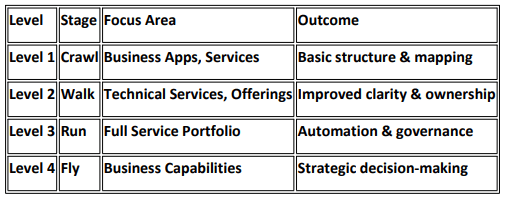
Module 5: Use Cases & Best Practices
- Incident Routing and Reporting Improvements
- Common Mistakes in CMDB/CSDM Projects
Next Steps & Adoption Guidance
- How to Assess Your Current CMDB State
- CSDM Adoption Strategy
- Explore:
- ServiceNow Docs
- CSDM Whitepapers
- Health Dashboards
Additional Topics (High-Level Only)
ServiceNow Discovery (Overview)
- What It Does: Automatically identifies and populates CIs in CMDB
- Types: Horizontal Discovery (infrastructure), Pattern-based Discovery (apps/services)
- Importance: Reduces manual errors, ensures real-time visibility
Service Mapping (Overview)
- What It Does: Maps business services to their underlying infrastructure
- Use Case: Helps in impact analysis during outages
- Outcome: Enables accurate service visibility and better RCA during incidents